
Underride truck accidents are among the deadliest types of crashes because a passenger vehicle can slide beneath a truck trailer, bypassing critical safety features and causing severe or fatal injuries. This guide explains why these collisions are so dangerous and why speaking with an experienced Pensacola truck accident lawyer may be important after a serious crash.

What Exactly Is an Underride Truck Accident?
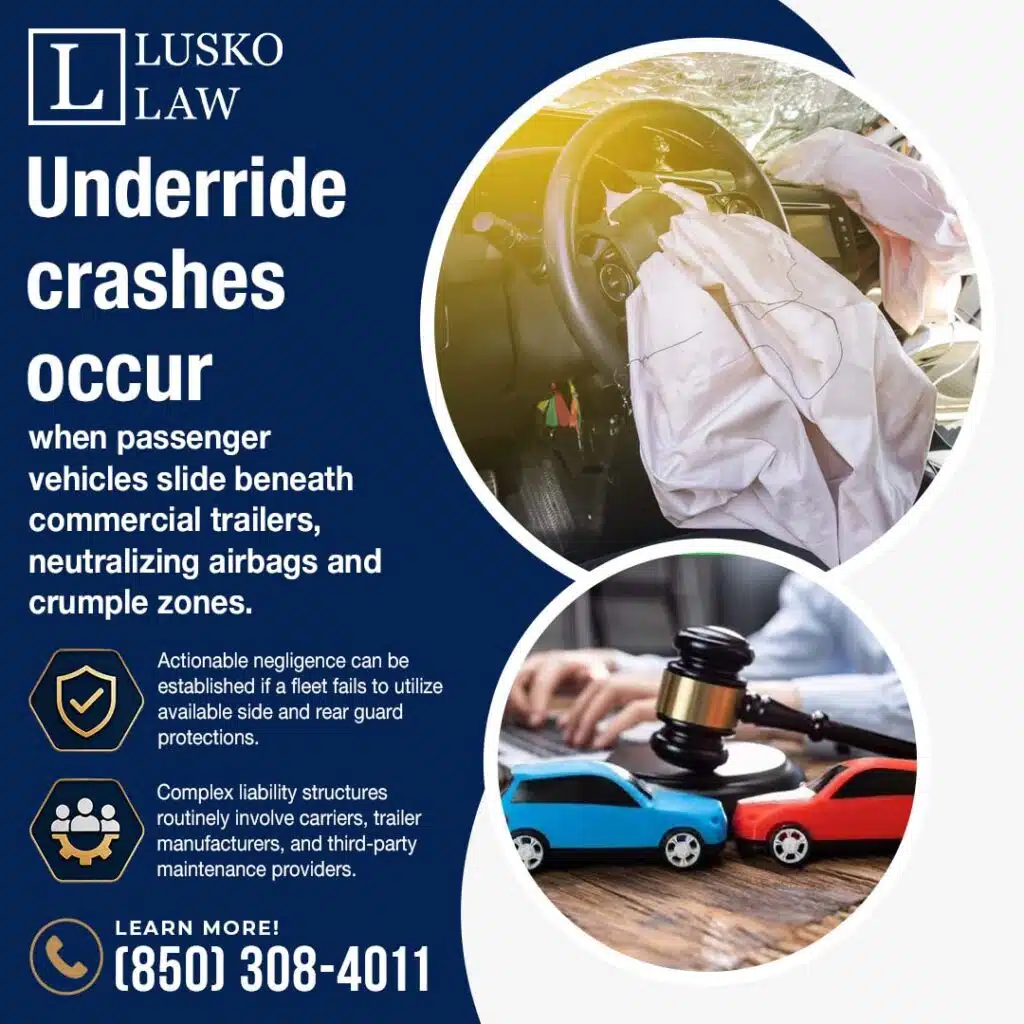
Unlike a typical vehicle collision, where two vehicles strike each other at roughly equal height, an underride accident occurs when a smaller car, SUV, or pickup slides beneath the rear or side of a large commercial trailer during or after impact. Passenger vehicles are engineered with crumple zones, side curtain airbags, and reinforced frames designed to absorb collision forces at standard vehicle height.
Those protections provide almost no defense when the undercarriage of a trailer cuts directly through the windshield and into the passenger compartment.
This is not an edge-case scenario. These crashes occur on highways and interstates every year, where long-haul commercial trucking routes intersect daily with high-speed commuter traffic.
Rear Underride vs. Side Underride
There are two primary categories of this crash type. A rear underride happens when a car collides with the back of a stopped or slowing truck and slides beneath the trailer. A side underride occurs when a vehicle is pushed laterally under the truck’s side, commonly during a lane-change collision, at an intersection, or in a multi-vehicle pileup.
Side underride accidents are considered especially dangerous because, under current federal law, most commercial trucks are not required to carry side underride guards. Rear guards are mandatory, but their quality and structural integrity vary considerably from trailer to trailer. Both types of crashes carry an alarmingly high rate of serious injury and death, and both demand thorough investigation from the moment a case begins.
The Deadly Physics Behind These Crashes
One of the most alarming realities about underride collisions is that they can be fatal at relatively low speeds, far lower than most people associate with a deadly crash. In a standard vehicle accident, speed is a primary determinant of injury severity. In an underride crash, the geometry of the impact takes over. When a car slides beneath a trailer, the vehicle’s roof, which is structurally far weaker than the front or sides, bears the direct force of the collision.
The consequences are severe and predictable. Injuries frequently include traumatic brain injury, cervical and upper-spinal fractures, severe facial trauma, and crush injuries to the chest and upper body. Even when occupants are properly restrained and traveling within posted speed limits, fatalities occur. These are the kinds of catastrophic, life-altering injuries that require a trucking accident lawyer with both the medical knowledge and investigative experience to build a case that accurately reflects the full scope of harm.
The Structural Vulnerability That Amplifies Harm
A car’s A-pillar, roof rail, and windshield frame are not designed to absorb the impact of a trailer undercarriage at any meaningful speed. When underride occurs, the trailer intrudes directly into the passenger compartment. There is no progressive energy absorption the way a front-end collision would allow through the engine bay, bumper, and chassis. The result is immediate and catastrophic.
This is why underride accidents carry a disproportionately high fatality rate compared to other truck crash categories, and why investigating the presence and condition of underride guards is among the first steps in every trucking collision case we take on.
A Regulatory Gap That Continues to Cost Lives
The trucking industry is subject to extensive federal regulation, yet one of the most dangerous gaps in those rules directly and repeatedly affects underride crash outcomes. Federal law currently mandates rear underride guards on most commercial trailers, but side underride guards remain largely unregulated for the vast majority of trucks on the road.
The consequences of this gap are well-documented and difficult to dismiss. According to the Insurance Institute for Highway Safety (IIHS), a federal mandate requiring side underride guards on commercial trailers could prevent approximately 160 to 220 passenger vehicle occupant fatalities every year, deaths that are preventable with a structural addition already in widespread use in other countries.
Separately, the NHTSA’s June 2024 Report to Congress on Side Underride Protection confirmed that underride fatalities are frequently underreported in crash databases, meaning the true annual death toll from these accidents is likely larger than official statistics reflect. The report spurred renewed legislative debate about strengthening both rear and side guard requirements for commercial trailers nationwide.
This regulatory gap carries real legal implications. When a trucking company has the means and knowledge to equip trailers with effective side guards but chooses not to, that decision can form the basis of a negligence claim, even where side guards are not technically required by current law. The absence of adequate protective equipment, or the installation of undersized guards, is a critical focal point in every underride case we investigate.
What Florida Law Says: Why It Matters for Your Case
Florida incorporates Federal Motor Carrier Safety Administration (FMCSA) regulations into state law through Florida Statute § 316.302. These standards establish enforceable requirements for vehicle equipment, driver hours of service, maintenance obligations, and cargo securement, creating a comprehensive framework that applies to every commercial truck operating within the state.
Comparative Fault and How It Affects Your Compensation
Florida’s modified comparative fault rule, codified under Florida Statute Section 768.81, is one of the most consequential statutes in any trucking injury case. Under this law, if an injured person is found to be more than 50% at fault for the accident, they may recover no compensation at all, even after suffering catastrophic, permanent injuries.
Trucking companies and their insurers understand this well. Their legal teams mobilize immediately after a crash to gather evidence and construct narratives that shift blame toward the passenger vehicle driver.
Early, aggressive legal intervention is the most effective counter to that strategy.
The Two-Year Window You Cannot Afford to Miss
Florida Statute Section 95.11 sets a two-year statute of limitations on personal injury and wrongful death claims arising from negligence. That window may feel generous, but underride cases require complex, time-sensitive investigation. A truck’s event data recorder, commonly called the black box, captures speed, braking, and throttle data in the seconds before impact.
Driver qualification files and hours-of-service logs reveal whether federal fatigue rules were violated. Maintenance records show whether required inspections were completed. These materials can be overwritten, lost, or destroyed if not formally preserved. Waiting to speak with a semi truck accident lawyer is a risk no injured victim should take.
Who May Be Held Liable After an Underride Collision
Liability in underride truck accidents is rarely confined to one party. Depending on the facts uncovered during the investigation, multiple entities may share responsibility for the crash and its consequences. At Lusko Law, we conduct thorough, evidence-driven investigations designed to identify every potentially liable party:
- The truck driver, for negligent, fatigued, distracted, or impaired operation
- The trucking company, for inadequate driver training, vehicle maintenance failures, or hours-of-service violations
- The cargo loader, if improperly secured freight caused a sudden stop or contributed to the collision dynamics
- The trailer manufacturer, if a defective or undersized underride guard failed to perform as designed at the moment of impact
- Third-party maintenance providers, if required inspections failed to identify guard degradation or structural defects
Gathering this evidence requires immediate action. We work to secure black box data, driver qualification files, cargo manifests, and maintenance logs, the documentation that tells the full, accurate story of why a crash happened and who bears legal responsibility.
Trial-Ready Representation That Fights for Every Victim
Trucking accident cases are significantly more complex than standard vehicle claims. They involve multiple defendants, intricate federal regulations, and insurance carriers with legal teams dedicated to minimizing what they pay to injured people.
Lusko Law was founded by Justin Lusko, a long-time Pensacola personal injury attorney with over a decade of experience representing seriously injured clients throughout the region.
Justin’s trial record reflects the stakes of the matters our firm handles. He secured a $7.5 million verdict in an Escambia County medical malpractice trial involving healthcare providers who failed to diagnose and treat a patient, resulting in an above-the-knee leg amputation. The same preparation and willingness to fight that drives those results is what he brings to complex trucking litigation.
Justin is a member of the Million Dollar Advocates Forum, one of the most prestigious trial lawyer organizations in the country. Fewer than 1% of U.S. lawyers qualify for membership.
As experienced truck accident lawyers, we understand the full weight of what our clients carry.
You will not be treated as a file number here. You will work directly with an attorney who communicates clearly, answers your questions promptly, and is fully committed to achieving the best possible result on your behalf.
Key Takeaways
- Underride crashes are uniquely lethal because they bypass a vehicle’s engineered safety protections, striking occupants in structurally vulnerable areas where crumple zones and airbags offer little defense.
- Side underride guards remain largely unregulated under federal law for most commercial trucks, despite IIHS data showing a mandate could prevent 160 to 220 deaths per year.
- Florida’s two-year statute of limitations under Section 95.11 means victims must act quickly to preserve critical evidence, including black box data and driver logs, before it is overwritten or destroyed.
- Multiple parties can share liability in an underride collision, including the truck driver, trucking company, cargo loader, and trailer manufacturer, making a thorough early investigation essential to a strong case.
- Florida’s comparative fault rule (Section 768.81) means that how fault is assigned directly determines how much you recover. Experienced legal representation from the start can significantly affect the outcome.
Ready to Fight for You: Contact Lusko Law After a Truck Crash
Underride collisions rank among the most catastrophic and legally complex accidents on the road. They leave victims facing permanent injuries, mounting medical bills, and lost income, while trucking companies and their insurers move quickly to protect their own interests.
At Lusko Law, we stand firmly on the side of injured individuals and their families across Pensacola and throughout Florida.
If you or a loved one has been hurt in a trucking accident, do not wait. Call us at (850) 308-4011 or email info@luskolaw.com to schedule a free consultation. An experienced truck accident lawyer in Pensacola, FL, is ready to review your case at no cost to you.