
Truck crashes rarely leave behind simple answers. A collision involving a commercial vehicle can produce catastrophic injuries, disputed timelines, and conflicting statements from multiple parties. That is why electronic evidence has become one of the most important tools in modern litigation. Many commercial trucks now contain event data recorders, often called black boxes, that capture operational details before and during a crash. A skilled Pensacola truck accident lawyer can use this information to identify negligent conduct, preserve critical evidence, and challenge inaccurate insurance defenses.
At Lusko Law, we regularly evaluate the technical evidence tied to commercial vehicle claims because trucking companies often begin protecting themselves immediately after a collision. Knowing how black box data works helps injured victims recognize why rapid legal action matters and how this technology can influence liability, settlement negotiations, and courtroom strategy.

Why Black Box Data Matters in Commercial Vehicle Cases
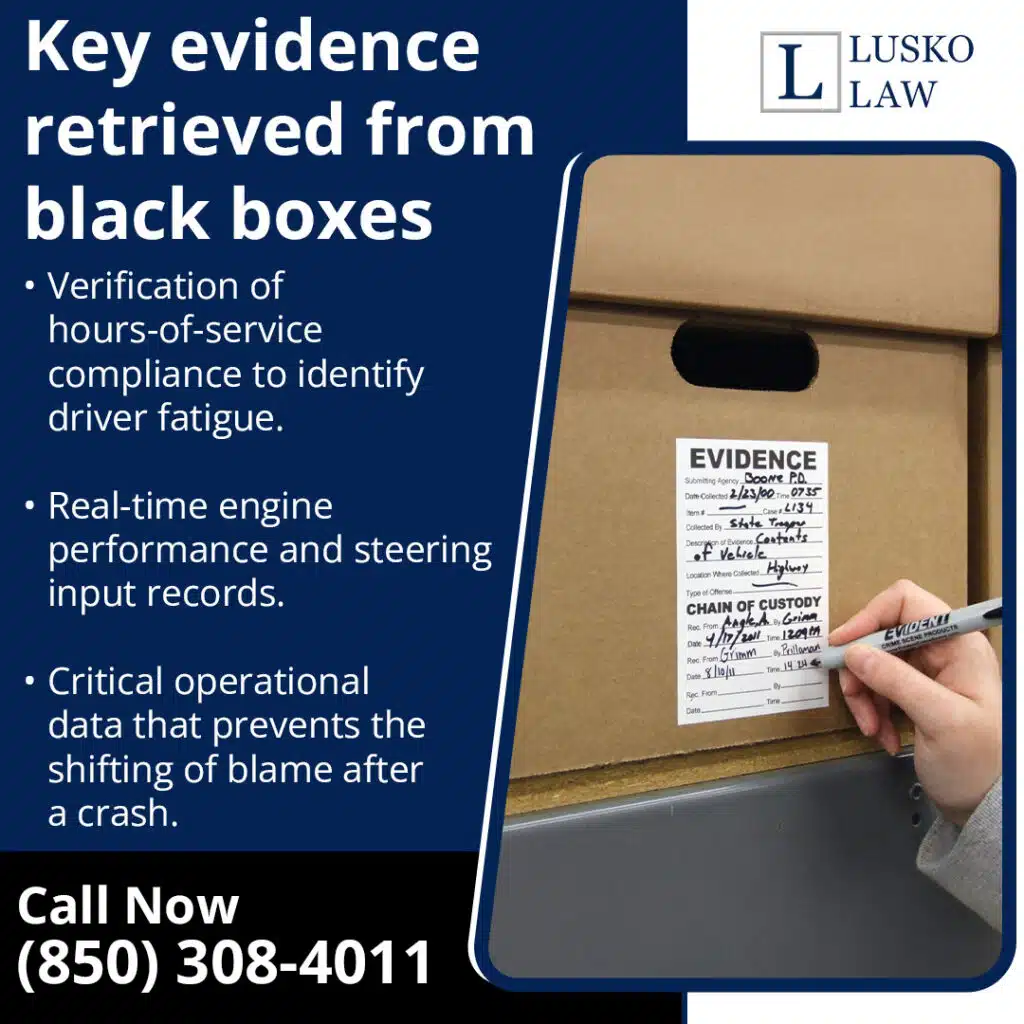
Black box systems record operational information from a truck’s electronic control modules. Depending on the vehicle and manufacturer, the system may capture speed, brake application, steering input, throttle position, seat belt use, engine hours, and sudden deceleration events. Some systems also store information connected to hours-of-service compliance and driver behavior.
For a truck accident lawyer in Pensacola, FL, this information can help reconstruct what happened seconds before impact. Instead of relying solely on witness recollections, attorneys can compare digital records against police reports, roadway evidence, and driver testimony.
Commercial carriers often move quickly after serious collisions. Their investigators may inspect vehicles within hours while the evidence is still fresh. We believe injured victims deserve the same level of preparation. Electronic data can reveal whether a driver attempted to brake, exceeded speed limits, or violated federal safety regulations.
Common Types of Data Retrieved After a Collision
The exact information stored inside a commercial truck depends on the system installed in the vehicle. However, several categories appear regularly in litigation involving trucking accident lawyers handling severe injury claims.
Event data recorders may preserve:
- Vehicle speed before impact
- Sudden braking activity
- Engine throttle percentages
- Cruise control usage
- Steering angle changes
- Driver hours and route history
- GPS movement records
- Mechanical fault alerts
This information becomes especially important when trucking companies deny liability or attempt to shift blame. A semi truck accident lawyer may use the records to show that a driver continued operating despite fatigue, failed to slow for traffic, or ignored maintenance warnings.
Electronic records also help investigators determine whether a collision could have been avoided. If the truck traveled above a safe speed for road conditions, the digital evidence may directly contradict statements made by the defense.
How Electronic Evidence Strengthens Injury Claims
Insurance companies frequently challenge the seriousness of trucking injury claims. They may argue that another driver caused the collision or suggest the injured person contributed to the crash. Objective electronic evidence can significantly weaken those defenses.
A truck accident lawyer often works with crash reconstruction experts who analyze black box downloads alongside roadway measurements and physical vehicle damage. Together, these details create a clearer timeline of events.
At Lusko Law, we understand that successful injury litigation depends on evidence preservation from the beginning of the case. Commercial carriers are not required to hold electronic records forever. If critical data is overwritten or destroyed, proving negligence becomes more difficult.
That is why immediate preservation letters matter. These notices instruct trucking companies to retain electronic records, maintenance documents, inspection reports, and communication logs related to the collision. Without prompt action, valuable evidence may disappear before litigation formally begins.
The Connection Between Black Box Data and Florida Negligence Law
Florida negligence law allows injured parties to pursue damages when another party’s carelessness contributes to a collision. Under Florida’s modified comparative negligence system, compensation may be reduced if an injured person shares responsibility for the crash.
Florida Statute 768.81 explains that contributory fault diminishes damages proportionately rather than automatically preventing recovery in most negligence actions. The law also requires courts to apportion damages according to each party’s percentage of fault instead of relying on broad joint liability standards.
For trucking accident lawyers, electronic evidence often becomes central to proving fault percentages because black box systems can preserve objective operational data before impact. If a trucking company claims a smaller passenger vehicle caused the collision, black box records may reveal the truck driver failed to brake in time, exceeded safe speed limits, ignored traffic conditions, or violated hours-of-service requirements.
Florida’s comparative fault framework also allows defendants to argue that nonparties contributed to the crash. Because of this, trucking litigation often becomes highly technical. Digital evidence may help establish whether maintenance providers ignored repair issues, cargo loaders improperly balanced freight, or manufacturers contributed to mechanical failures.
These cases frequently involve multiple defendants. Liability may extend beyond the driver to include:
- Trucking companies
- Maintenance contractors
- Cargo loading companies
- Vehicle manufacturers
- Logistics providers
A trucking accident lawyer in Florida must identify every potentially responsible party while preserving the evidence connected to each entity. Digital records often reveal whether the company ignored inspection problems, pressured drivers to exceed safe operating limits, or violated federal transportation regulations.
What Black Box Data Can Reveal About Driver Fatigue
Recent academic research has further demonstrated how modern vehicle black box systems strengthen accident analysis and emergency response efforts. A 2025 study published in the International Journal of Creative Research Thoughts examined how IoT-connected black box systems can continuously monitor vehicle performance, detect sudden impacts through MEMS sensors, and automatically transmit GPS coordinates to emergency responders after a collision.
The researchers also highlighted how integrated data collection can improve accident reconstruction accuracy by preserving operational details tied to vehicle movement, obstacle detection, and driver behavior.
For legal claims involving catastrophic trucking collisions, these developments matter because digital evidence can help establish whether dangerous driving behavior, delayed braking, fatigue, or mechanical failures contributed to the crash. Black box systems increasingly provide objective data that attorneys and reconstruction experts can analyze during litigation.
Driver fatigue remains one of the most dangerous issues in commercial transportation. Long hours behind the wheel reduce reaction time, impair judgment, and increase stopping distance. Black box systems and electronic logging devices can provide insight into whether a driver exceeded legal operating hours.
A Pensacola truck accident lawyer team may examine electronic records to determine whether the driver:
- Exceeded federal driving hour limits
- Skipped required rest breaks
- Altered driving logs
- Continued operating while fatigued
- Ignored dispatch pressure to meet deadlines
These details can dramatically affect settlement value and jury perception. When digital evidence shows a trucking company knowingly permitted unsafe conduct, the defense position often weakens.
Why Preservation Timing Is Critical
Many trucking systems overwrite information after a certain period or after continued vehicle operation. That means delays can permanently eliminate important evidence.
We encourage injured individuals to seek legal guidance quickly after a commercial vehicle crash because timing directly impacts evidence preservation. A semi truck accident lawyer’s team may immediately coordinate with experts to secure downloads from the truck’s onboard systems before repairs, disposal, or reuse affects the records.
At Lusko Law, we prioritize early investigation because trucking litigation moves quickly. Insurance carriers, defense attorneys, and corporate investigators often begin building their defense immediately after a serious collision.
How Defense Teams Challenge Electronic Trucking Evidence
Although black box information can be powerful, defense teams frequently attempt to limit its impact. They may argue that the system malfunctioned, recorded incomplete information, or failed to capture the full circumstances surrounding the crash.
A trucking accident lawyer must, therefore, connect electronic evidence with additional supporting proof. This often includes:
Expert Reconstruction Analysis
Accident reconstruction specialists evaluate crash angles, skid marks, roadway debris, vehicle damage, and impact forces. When their findings align with black box downloads, the evidence becomes more persuasive.
Maintenance and Inspection Records
Mechanical failure claims require close examination of service histories. Electronic data may reveal repeated warning indicators or system faults ignored before the collision.
Driver Qualification Files
Commercial carriers must maintain records involving training, licensing, prior violations, and medical certification. A truck accident lawyer’s team in Pensacola may compare those records against the crash evidence to identify broader safety failures.
Defense teams also attempt to shift fault onto injured motorists. However, objective digital records frequently expose inconsistencies in those arguments. If the truck driver never attempted braking before impact, for example, the defense may struggle to justify claims that the collision was unavoidable.
The Role of Trial Preparation in Trucking Litigation
Many truck accident cases settle before trial, but settlement strength often depends on courtroom readiness. Trucking companies and insurers typically invest substantial resources into defending serious injury claims. They know that jury verdicts involving catastrophic injuries can be significant.
At Lusko Law, we approach commercial vehicle cases with thorough preparation because strong evidence presentation often shapes negotiation outcomes long before the trial begins. Our litigation strategy focuses on building a clear narrative supported by documented evidence, expert analysis, and technical records.
A truck accident lawyer may use black box evidence to establish:
- Unsafe speed before impact
- Delayed braking response
- Driver distraction
- Hours-of-service violations
- Mechanical failures
- Negligent company oversight
This approach helps juries understand that trucking collisions rarely result from a single moment alone. Many serious crashes stem from preventable decisions made long before impact.
Key Takeaways
- Electronic truck data can preserve objective evidence that clarifies how a crash occurred.
- Early evidence preservation is essential because some systems overwrite records quickly.
- Digital records may reveal speeding, fatigue, braking failures, or federal safety violations.
- Florida negligence rules make fault allocation especially important in trucking litigation.
- Technical evidence often strengthens settlement negotiations and trial preparation.
Speak With a Legal Team Prepared to Investigate Complex Trucking Claims
Truck accident litigation demands more than reviewing police reports and insurance paperwork. These cases often involve federal regulations, electronic evidence preservation, expert analysis, and aggressive defense strategies. Working with experienced counsel can help injured individuals protect crucial evidence before it disappears.
At Lusko Law, we understand the serious financial and physical consequences that follow commercial vehicle collisions. Our team focuses on detailed investigations, direct communication, and trial-ready preparation designed to protect injured clients throughout the legal process. If a trucking collision has disrupted your life, we are prepared to evaluate the evidence, explain your legal options, and pursue accountability from the responsible parties. To learn more, contact us today at (850) 308-4011 or info@luskolaw.com.