
Florida summers and open water go hand in hand, but the risk on those waterways is real. Pensacola, FL, personal injury lawyers at Lusko Law see the consequences of boating accidents every season: broken bones, head trauma, spinal injuries, and disabling harm that sidelines working people for months. If you were hurt on the water and someone else’s negligence played a role, you have legal options worth understanding.

What Is the Boat Accident Injury Claims Process in Florida?
Filing a claim after a Florida boating accident generally follows five steps:
- Get medical treatment and document your injuries. Medical records establish the link between the accident and your harm, the foundation of any claim. Acting quickly on treatment also matters for the claim itself, since delayed medical care can hurt a Florida injury claim.
- Report the accident. Florida law requires reporting boating accidents involving injury, death, or significant property damage to the FWC.
- Preserve evidence quickly. Witness statements, photos of the vessel and scene, and Coast Guard or FWC incident reports disappear or change fast, since vessels get repaired or sold within days.
- Identify every liable party and insurance source. This may include the operator’s boat insurance, a rental company’s policy, or applicable homeowners’ coverage, since boat insurance isn’t mandatory in Florida.
- Consult a personal injury attorney before accepting any settlement. An attorney evaluates all available coverage and negotiates before insurers undervalue your claim.
Florida law allows injured boaters to pursue compensation when another party’s negligence caused the accident. To build a strong claim, several elements must be established: that the other party owed a duty of care, that they breached it, and that the breach directly caused measurable harm.
Why Are Florida Boating Accidents So Common in Summer?
Florida leads the nation in registered recreational vessels, with more than one million registered boats statewide.
According to the Florida Fish and Wildlife Conservation Commission’s 2024 Boating Accident Report, the state recorded 685 reportable boating accidents and 81 fatalities in a single year, the highest in the country. Summer months drive the numbers up sharply as recreational traffic on the Gulf, bays, and inlets surges.
Common causes include operator inattention, excessive speed, alcohol use, and collisions with fixed objects. Critically, 65 percent of operators involved in fatal accidents had received no formal boating training.
What Types of Injuries Result from Boating Accidents?
Boating crashes tend to produce severe trauma. Victims frequently suffer lacerations from propeller strikes, traumatic brain injuries from impact with vessel components, spinal cord damage, and near-drowning injuries that cause lasting organ damage.
Passengers who are ejected from a moving vessel face some of the worst outcomes. These injuries often require extended medical treatment, surgery, and rehabilitation, leaving many victims unable to work for extended periods.
What Compensation Can You Recover After a Florida Boating Accident?
Recoverable damages typically include medical expenses (past and future), lost wages, pain and suffering, and emotional distress. The exact value of a claim depends on the severity of your injuries and how clearly the other party’s negligence caused them.
For a closer look at when a lawsuit is the right path, see our guide on whether you can sue for a boating accident injury in Florida.
Evidence is time-sensitive in boating cases. Witness accounts fade, vessels get repaired or sold, and physical evidence at the scene disappears quickly. Acting fast matters. Lusko Law begins by gathering all available evidence: marine incident reports, witness testimony, Coast Guard records, and medical documentation, to build a case that reflects the full scope of your losses.
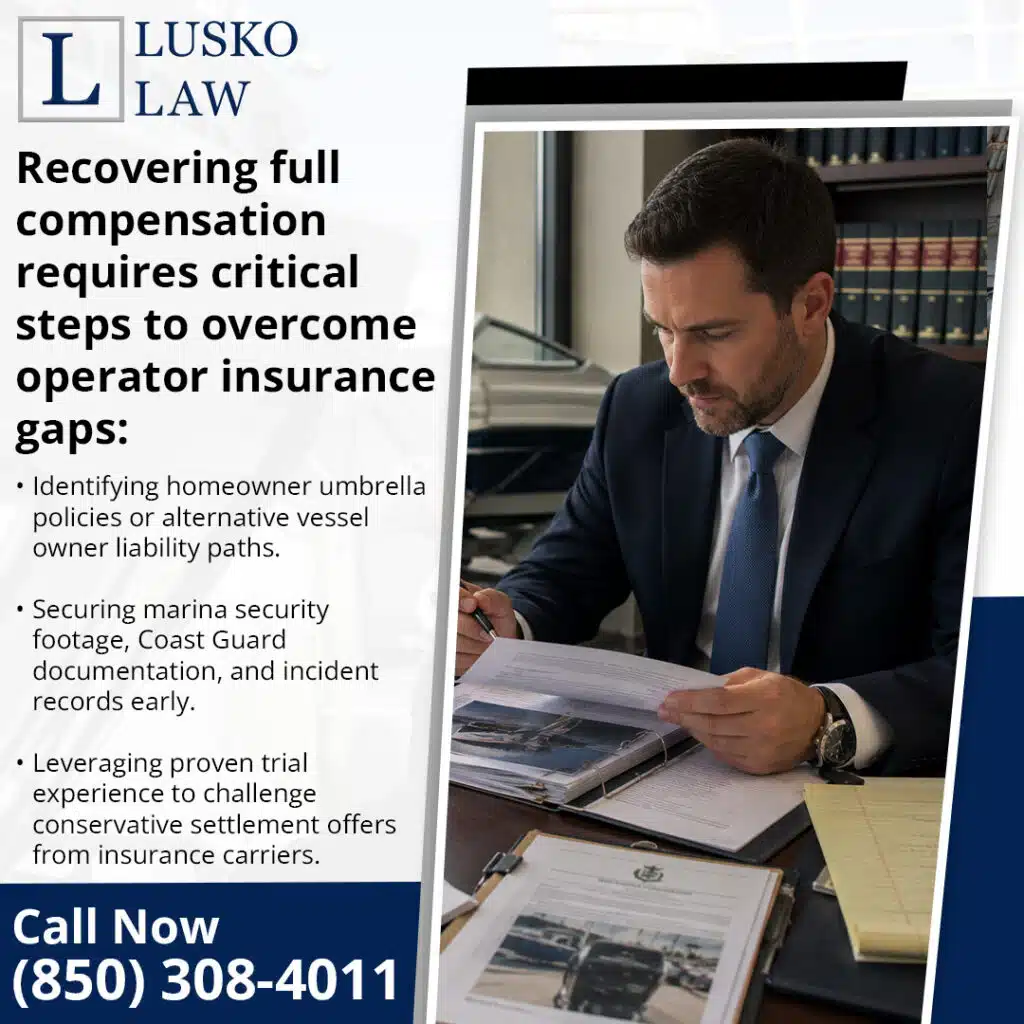
Does Boat Insurance Cover Your Injuries?
Unlike car insurance, boat insurance is not mandatory in Florida. That means the operator who injured you may be underinsured or carrying no coverage at all.
An experienced Pensacola personal injury attorney can evaluate all potentially available sources of recovery, which may include applicable boat insurance policies, certain homeowners’ insurance provisions, or other available coverage, depending on the circumstances. Understanding these layers is critical to recovering full compensation.
How Long Do You Have to File a Boating Accident Claim in Florida?
Florida law imposes a filing deadline for boating accident injury claims, and recent changes to Florida’s negligence laws have shortened some of these windows. Waiting to speak with an attorney risks losing your right to file altogether.
Because the applicable deadline depends on the specifics of your accident, the safest approach is to consult an attorney as soon as possible rather than assume you have more time than you do.
At Lusko Law, there are no upfront attorney fees. Our firm works on a contingency basis, meaning you owe nothing unless we recover for you. That model exists so that anyone hurt on Florida’s waters can access serious legal representation without paying attorney fees upfront.
If a summer boating accident has left you injured and unable to work, don’t wait to understand your rights. Reach out to our personal injury lawyers in Pensacola, FL, at Lusko Law at (850) 308-4011 or info@luskolaw.com for a free, no-obligation consultation today.