
Surgery carries inherent risk, but not every bad outcome is acceptable. When a healthcare provider’s carelessness, inattention, or failure to follow established protocols causes you harm, the law gives you the right to hold them accountable.
For patients throughout the Florida Panhandle, understanding what qualifies as a surgical error and what your legal options look like is the first step toward justice. As medical malpractice attorneys in Pensacola, Florida, our team at Lusko Law sees firsthand how these injuries devastate families financially, physically, and emotionally. This guide breaks down what surgical malpractice means, how Florida law frames these claims, and what you should do if you believe negligence played a role in your outcome.
What Qualifies as a Surgical Error Under Florida Law?
Not every complication following surgery rises to the level of malpractice. Florida Statutes § 766.102 establishes that medical malpractice occurs when a healthcare provider deviates from the accepted standard of care, meaning what a reasonably competent provider in the same specialty would have done under similar circumstances. The outcome must be directly linked to that deviation.
Surgical errors that commonly give rise to malpractice claims include:
- Wrong-site Surgery: Operating on the wrong limb, organ, or body part
- Retained Surgical Instruments: Leaving sponges, clamps, or tools inside a patient after closure
- Anesthesia Errors: Administering incorrect dosages or failing to monitor the patient’s response
- Nerve or Tissue Damage: Caused by improper technique or intraoperative negligence
- Postoperative Neglect: Failure to identify or treat complications during recovery
The threshold question is always whether the provider met the standard of care. Known surgical risks, properly disclosed, are generally not actionable. What matters is whether the error was preventable.
Retained Foreign Bodies: A Common and Serious Error
Among the most documented surgical errors are retained foreign bodies, meaning instruments or materials left inside a patient’s body. These are classified as “never events” because they should never happen when proper protocols are followed. Identifying this type of error can take weeks or months, as symptoms may only emerge as infections or internal injuries develop.
How Common Are Surgical Errors, and Why Do They Happen?
The scope of the problem is broader than most patients realize. The National Practitioner Data Bank (NPDB), as published by the National Institutes of Health (NIH/NCBI), was created specifically to track malpractice judgments and disciplinary actions against healthcare providers nationwide.
Importantly, the NPDB itself recognizes that malpractice settlements recorded in its system are reached for a variety of practical reasons and do not always reflect a finding of incompetence or a clear breach of the standard of care. This distinction matters: a settlement appearing in a provider’s record is not automatically an admission of wrongdoing, which is precisely why injured patients need experienced legal counsel to build a case grounded in evidence, not assumptions.
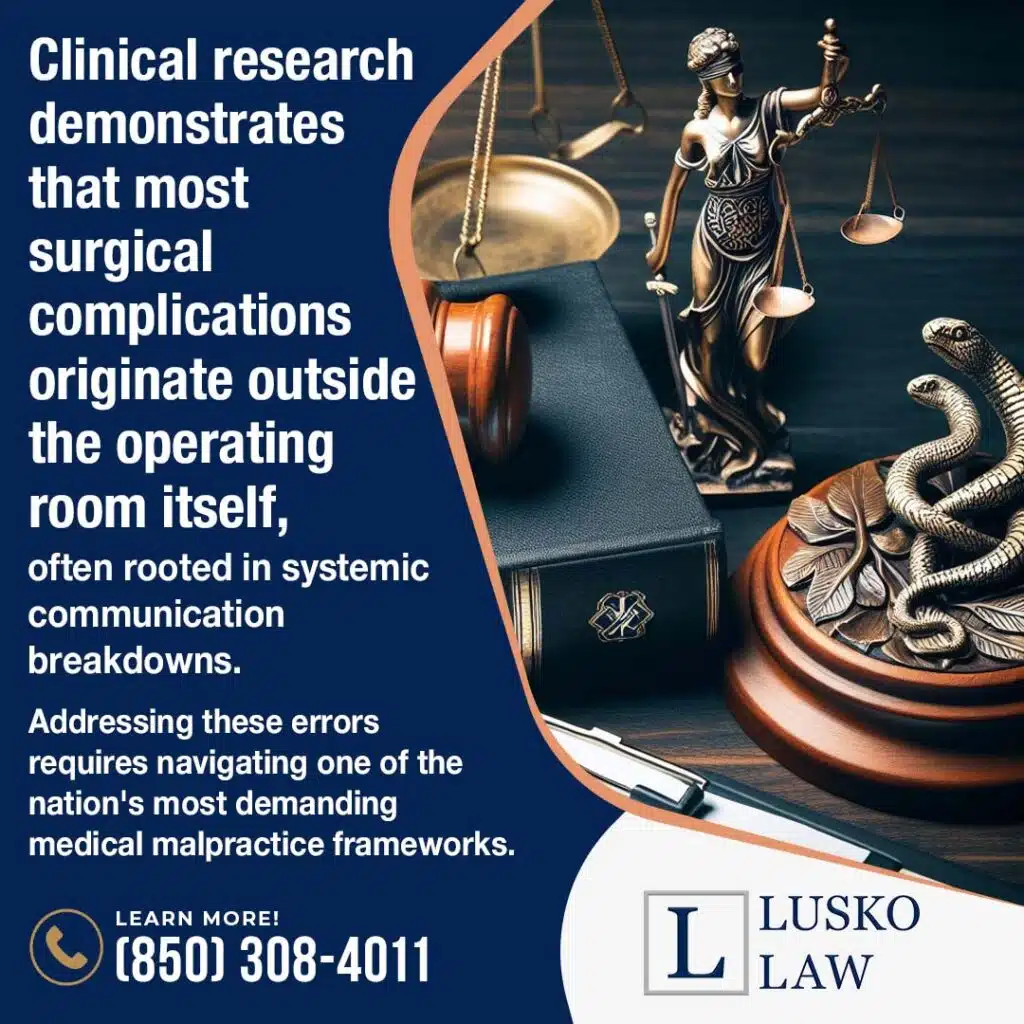
Research reviewing surgical errors across multiple specialties has found that many preventable mistakes occur before or after surgery, not just in the operating room itself. Common contributing factors include communication breakdowns, inadequate safety procedures, and failures in patient care coordination.
These findings highlight an important reality: surgical errors often follow identifiable patterns. Fatigue, communication failures, and lapses in safety protocols can all contribute to patient harm, making a thorough investigation essential when serious complications occur.
Why Florida Patients Face Unique Challenges
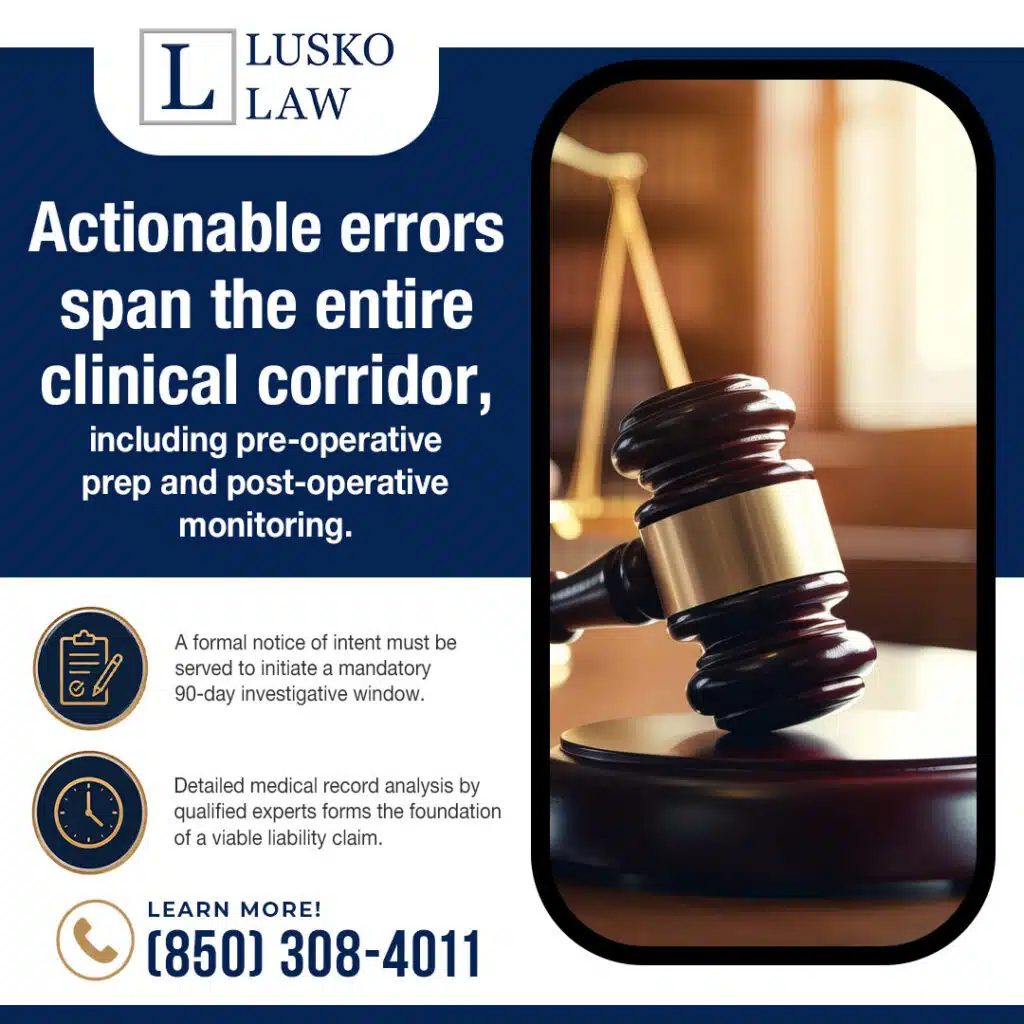
Florida’s healthcare landscape is expansive, and its legal framework for malpractice claims is among the most procedurally demanding in the country. Before filing a lawsuit, Florida law under § 766.106 of the Florida Statutes requires claimants to complete a formal presuit investigation and serve a notice of intent to the defendant healthcare provider.
This triggers a mandatory 90-day period during which the defendant may investigate, offer a settlement, or reject the claim. During this window, the statute of limitations is paused (tolled).
Failing to comply with this presuit requirement can result in a claim being dismissed entirely, not on its merits, but on procedural grounds. This is one reason having experienced legal counsel from the outset is not just helpful; it is essential.
Florida’s Statute of Limitations: Don’t Wait Too Long
Time is one of the most critical factors in any surgical malpractice case. Florida generally imposes a two-year statute of limitations from the date a patient discovers, or should reasonably have discovered, that their injury may be linked to medical negligence. An absolute four-year statute of repose applies regardless of discovery, with narrow exceptions for fraud or concealment.
The Discovery Rule and Why It Matters
For surgical error cases, the discovery rule often becomes central. If a patient had no way of knowing that a retained instrument or a botched repair caused their symptoms, the two-year clock typically does not start until that connection becomes, or reasonably should become, apparent. This is particularly relevant in cases involving:
- Infections tracing back to retained materials
- Internal damage that was not identified during hospitalization
- Complications from anesthesia that manifest weeks after surgery
Even if you are uncertain whether your window has passed, consulting a medical malpractice lawyer in Pensacola, FL, early preserves your options. Waiting does the opposite.
What Compensation Can Surgical Malpractice Victims Recover?
A successful surgical malpractice claim can result in compensation for a broad range of losses.
At Lusko Law, we pursue every category of damages our clients are entitled to, including:
- Past and Future Medical Expenses: Corrective surgeries, rehabilitation, and ongoing care
- Lost Wages and Earning Capacity: When the injury limits your ability to return to work
- Pain And Suffering: Covering both physical pain and emotional distress
- Loss of Enjoyment of Life: When an injury permanently changes what you can do
- Punitive Damages: In cases involving egregious or reckless conduct
No two cases are identical. The damages available depend on the nature of the error, the severity of the resulting harm, and how that harm has affected every aspect of your life. Our team builds each case with those specifics front and center.
The Value of Trial-Ready Representation
Insurance companies that defend hospitals and surgeons know which law firms take cases to trial and which ones settle for less. That distinction matters enormously to your outcome.
Attorney Justin Lusko has secured multi-million dollar trial verdicts in Escambia County for surgical malpractice victims, including a $7.5 million verdict after healthcare providers failed to diagnose and treat a patient who subsequently suffered an above-the-knee amputation, and a $2.625 million verdict for a patient whose internal bleeding went undertreated due to provider negligence. These results reflect a firm that prepares every case as if it will go before a jury, because sometimes it should.
How We Build a Surgical Malpractice Case
Surgical malpractice claims require far more than documenting an injury. They demand a systematic investigation guided by medical expertise and legal precision. When you bring your case to Lusko Law, here is what that process looks like:
- Medical Record Review: We obtain and analyze every page of your surgical records, anesthesia notes, nursing documentation, and postoperative reports. Inconsistencies, gaps, and deviations from standard charting protocols are significant.
- Expert Consultation: Florida law requires that a qualified medical expert affirm the existence of negligence before a case can proceed. We work with credentialed specialists in the relevant surgical discipline who can articulate precisely how care fell short of the accepted standard.
- Evidence Preservation: We move quickly to preserve time-sensitive materials, including surgical video footage, instrument logs, hospital incident reports, and staff scheduling records, before they are altered or destroyed.
- Strategic Demand and Negotiation: With a thoroughly documented case, we present a compelling demand to the insurer. If their offer does not reflect what our client deserves, we proceed to trial.
Injured by a Surgical Error? Get the Legal Advocacy You Deserve
If you or someone you love suffered harm during or after surgery in the Pensacola area, your next step matters. The attorneys at Lusko Law have spent the past decade fighting for patients harmed by medical negligence and winning. As medical malpractice lawyers in Pensacola, FL, we know what these cases demand, and we build them to win.
Call us at (850) 308-4011 or email info@luskolaw.com to schedule your confidential consultation. Time limits apply, so do not wait.