
Trucking Wrecks
Trucking Wrecks
Commercial trucks are the backbone of the American supply chain — and one of the most serious hazards on Florida’s roads. A fully loaded tractor-trailer can weigh up to 80,000 pounds, compared to roughly 4,000 pounds for the average passenger vehicle. When something goes wrong at highway speed, it is rarely the truck’s occupants who bear the consequences. The physics are unforgiving, and the injuries that result — spinal trauma, traumatic brain injury, severe fractures, internal injuries — are among the most catastrophic seen in personal injury litigation.
Florida experiences thousands of commercial truck crashes each year, according to federal transportation safety data compiled through the FMCSA and related reporting systems. In the Pensacola area, Interstate 10 through Escambia and Santa Rosa Counties serves as a major commercial freight corridor connecting traffic across the Gulf Coast region. The I-110 connector, US-98, and the approaches to the Port of Pensacola add further commercial traffic to local roads already shared with commuters, tourists, and residents. Crashes involving tractor-trailers, dump trucks, tankers, and box trucks are a documented and recurring reality in this region — and the consequences are consistently severe.
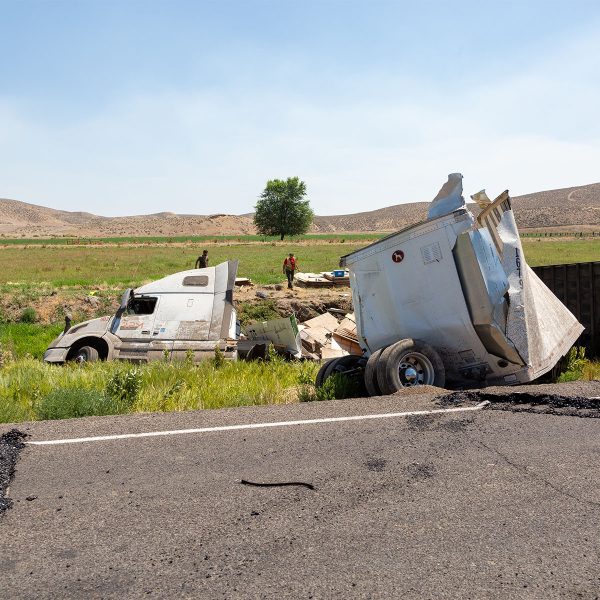
What makes trucking wreck cases fundamentally different from standard car accident claims is the regulatory framework that governs every commercial truck on the road. The FMCSA sets mandatory federal safety standards covering driver hours of service, vehicle maintenance, driver qualifications, drug and alcohol testing, and cargo loading. Under 49 CFR Part 395, a property-carrying commercial driver generally may drive no more than 11 hours after 10 consecutive hours off duty, may not drive beyond the 14th consecutive hour after coming on duty, and must take a qualifying 30-minute break before driving after eight cumulative hours of driving time. These rules exist because fatigue is one of the leading causes of truck crashes — and violations of these rules, when they occur, can be powerful evidence of negligence.
Since December 2017, most commercial trucks have been required to use Electronic Logging Devices (ELDs), which automatically record driving time and hours of service data in real time. Combined with onboard event data systems and engine control modules, these devices may capture speed, braking activity, throttle position, and operational data in the moments before a crash. This evidence does not wait. Trucking companies and their insurers begin their own investigations within hours of a serious accident, and critical data can be lost, overwritten, or become the subject of legal dispute if not preserved quickly. Early legal intervention is not just advisable in trucking wreck cases — it is essential.
Establishing liability in a truck accident case also requires identifying every potentially responsible party — and there are often more of them than an injured person might initially expect. The truck driver may be directly at fault. The trucking company may be liable for inadequate training, negligent hiring, failure to maintain the vehicle, or for pressuring a driver to violate hours-of-service limits. A cargo loading company may have improperly secured or overloaded a trailer, contributing to a rollover or load-shift event. A maintenance provider may have signed off on brakes or tires that were unfit for the road. Identifying and preserving claims against all responsible parties matters, because motor carriers are generally required under federal law to maintain substantially higher insurance minimums than private motorists, including minimum liability coverage of $750,000 for many interstate freight carriers and higher limits — including up to $5,000,000 — for certain hazardous materials operations. That also means their legal teams are well-funded and will move aggressively to limit what they pay.
Under Florida’s modified comparative negligence system, a claimant who is found more than 50% at fault for most negligence claims may be barred from recovering damages. Defense attorneys in truck accident cases routinely attempt to shift blame onto the passenger vehicle driver — arguing that they followed too closely, drove in a blind spot, failed to yield, or changed lanes unsafely. Countering these arguments requires evidence gathered promptly and thoroughly. In Florida, negligence claims arising from truck accidents are generally subject to a two-year statute of limitations, but the investigation needs to begin well before that deadline to be effective.
At Lusko Law, we handle trucking wreck cases with the same depth and tenacity that Justin Lusko has brought to complex personal injury litigation in Pensacola for over a decade. We move quickly to preserve ELD data, event recorder data, driver logs, maintenance records, and inspection histories. We identify every liable party, understand the federal regulatory framework governing your case, and build the strongest possible record on your behalf — pursuing full compensation for your medical expenses, lost earnings, future care needs, pain and suffering, and all other damages you are entitled to recover.
Our Personal Approach
A trucking wreck can change everything in an instant. In the hours and days that follow a serious crash, you are dealing with medical treatment, physical pain, insurance adjusters, and the weight of not knowing what comes next. The last thing you need is a law firm that treats your case like a number in a queue.
Our approach begins with truly listening. We want to understand what happened, how it has affected your life, and what matters most to you as we move forward. You will have direct access to an attorney throughout your case, with clear communication and regular updates at every stage of the process. We communicate clearly, respond promptly, and keep you informed throughout the process. A trucking wreck case can involve federal investigators, multiple corporate defendants, and insurance carriers with substantial resources on their side. We bring the preparation, the persistence, and the trial experience to level that playing field for you.
Transparent Service Fees
- Interested in discussing your potential case?
Past Results Disclaimer (Florida Bar Required): Prior verdicts and settlements referenced in connection with Lusko Law reflect results obtained in prior cases and do not guarantee a similar outcome in any trucking wreck or other matter. Most cases result in a lower recovery. It should not be assumed that your case will have as beneficial a result.
This page is for informational purposes only and does not constitute legal advice. No attorney-client relationship is formed by viewing this page. Trucking wreck claims in Florida are subject to a two-year statute of limitations under Florida Statute § 95.11. Federal regulations referenced herein are sourced from the Federal Motor Carrier Safety Administration (FMCSA) and 49 CFR Parts 387 and 395. Florida comparative fault rules under § 768.81 may affect recovery. Contact Lusko Law promptly to preserve your rights